

Listen to the Podcast!
The first year after having a baby can feel like emotional whiplash.
One minute you’re staring lovingly at your sleeping newborn thinking, I would die for this tiny human.
The next minute you’re arguing over whose turn it is to wash pump parts while eating cold leftovers at 9:30pm.
And honestly? Both experiences are normal.
One of the biggest misconceptions about the postpartum period is that the hardest part is birth itself. But for many families, the real challenge begins after everyone goes home. Especially when one partner returns to work quickly while the other remains home recovering, feeding, managing naps, and trying to function on broken sleep.
This season can place enormous pressure on relationships, mental health, nervous systems, and family dynamics. Not because you’re doing anything wrong, but because modern parenting often asks families to do too much with too little support.
As a birth, postpartum, and sleep doula, I work with families in this exact stage every day. And the families who navigate this season best usually are not the “perfect” parents.
They’re the ones who learn how to slow down, communicate better, ask for help, and stop expecting themselves to function like they did before the baby arrived.
Here are ten practical tips for partners navigating the newborn and baby stage together.
1. When Things Escalate, Pause Before You Push Through
There will be moments where everyone is overstimulated.
The baby is crying.
Someone hasn’t eaten.
The dog is barking.
You’re late for work.
The bottle spilled.
Nobody slept.
This is not the moment to “power through” emotionally.
One of the healthiest things a partner can learn during postpartum is how to recognize nervous system overload before it becomes a full argument or shutdown.
Sometimes the best move is:
putting the baby somewhere safe,
stepping outside for a minute,
taking a few breaths,
and resetting before reentering the situation.
This is not avoidance.
It’s regulation.
And regulated adults make better decisions.
2. Don’t Give Your Family Only the Leftover Version of You
Many working parents are carrying intense pressure during the first year:
financial stress,
sleep deprivation,
performance expectations at work,
and guilt about not being home more.
It’s easy to unintentionally give your best energy to work and your exhausted leftovers to your family.
But small moments of connection matter deeply during postpartum.
Holding the baby so your partner can shower.
Refilling their water bottle without being asked.
Cleaning pump parts.
Sitting on the floor to play for ten minutes before checking your phone.
These things may seem small, but they communicate:
“We’re in this together.”
And that matters more than grand gestures.
3. Play More Than You Think You Need To
When families are overwhelmed, everything can start feeling transactional:
feed the baby,
wash bottles,
change diapers,
repeat.
But babies build connection through play.
And honestly? Parents reconnect through play too.
You do not need elaborate activities or expensive toys. Babies under one are incredibly easy to entertain.
Silly faces.
Songs during diaper changes.
Dancing in the kitchen.
Rolling around on the floor.
Play helps diffuse stress and creates moments of connection during a season that can otherwise feel like nonstop logistics.
4. Leave the House Before Cabin Fever Takes Over
Especially for the parent home with the baby all day, isolation can build quickly.
Many new parents unintentionally spend days or weeks cycling between:
feeding,
naps,
dishes,
laundry,
and trying to survive until bedtime.
Getting out of the house matters for mental health.
Not because you need to “bounce back” or stay productive, but because humans are not meant to function in isolation.
Go for a walk.
Walk through Target.
Get coffee.
Sit outside.
Tiny outings often help everyone regulate better, including babies.
5. Recovery Lasts Longer Than Most People Expect
One of the biggest relationship stressors postpartum is mismatched expectations around recovery.
Even when birth goes smoothly, the birthing parent is still recovering physically, hormonally, mentally, and emotionally for months afterward.
Add in:
sleep deprivation,
feeding challenges,
identity shifts,
and the invisible mental load of parenting…
…and many parents are functioning while profoundly depleted.
If your partner seems more emotional, anxious, irritable, or unlike themselves, lead with curiosity instead of defensiveness.
Support during postpartum is not just physical help.
It’s emotional safety too.
6. Stop Trying to Maintain Your Pre-Baby Pace
Everything takes longer with a baby.
Everything.
Leaving the house.
Getting groceries.
Traveling.
Doing bedtime.
Getting everyone fed.
Yet many families continue trying to maintain the same schedules and productivity they had before children.
This often leads to overwhelm, resentment, and burnout.
The first year is a season where slower is normal.
Build margin into your schedule whenever possible.
Plan fewer activities.
Expect transitions to take longer.
This is not failure.
It’s adaptation.
7. Use Your Support Systems and Experts
Modern parenting often places unrealistic expectations on families to figure everything out alone.
But humans were never designed to raise babies in isolation.
Use your support systems:
postpartum doulas,
lactation consultants,
pelvic floor therapists,
pediatricians,
sleep consultants,
therapists,
parent groups,
trusted friends.
Sometimes one supportive conversation can prevent weeks of stress and confusion.
Asking for help is not weakness.
It’s resourcefulness.
8. Talk Honestly With Other Parents
One of the fastest ways to reduce shame during postpartum is realizing other families are struggling too.
Social media often creates the illusion that everyone else is handling parenting better.
They are not.
Most families are navigating:
sleep deprivation,
relationship stress,
feeding struggles,
overstimulation,
and uncertainty in some form.
Honest conversations normalize the experience of early parenthood and reduce the pressure to pretend everything is fine.
9. Taking Care of Yourself Is Not Selfish
Many partners feel guilty prioritizing their own needs during postpartum, especially if the birthing parent is struggling.
But burnout helps nobody.
Basic self-care during the first year matters:
hydration,
food,
sleep,
movement,
rest,
downtime,
emotional support.
You do not need a perfect wellness routine.
You need enough support to keep functioning like a human being.
Regulated adults create more regulated households.
10. Trust Yourself More Than the Internet
The internet is full of opinions about parenting.
Schedules.
Sleep training.
Feeding.
Wake windows.
Milestones.
Daycare.
Screen time.
Information can absolutely be helpful.
But at some point, you also have to learn your own child.
You are the expert on your baby’s patterns, temperament, cues, and needs.
Outside support should help you feel more informed and empowered, not more disconnected from your intuition.
You do not have to parent exactly like everyone else to be a good parent.
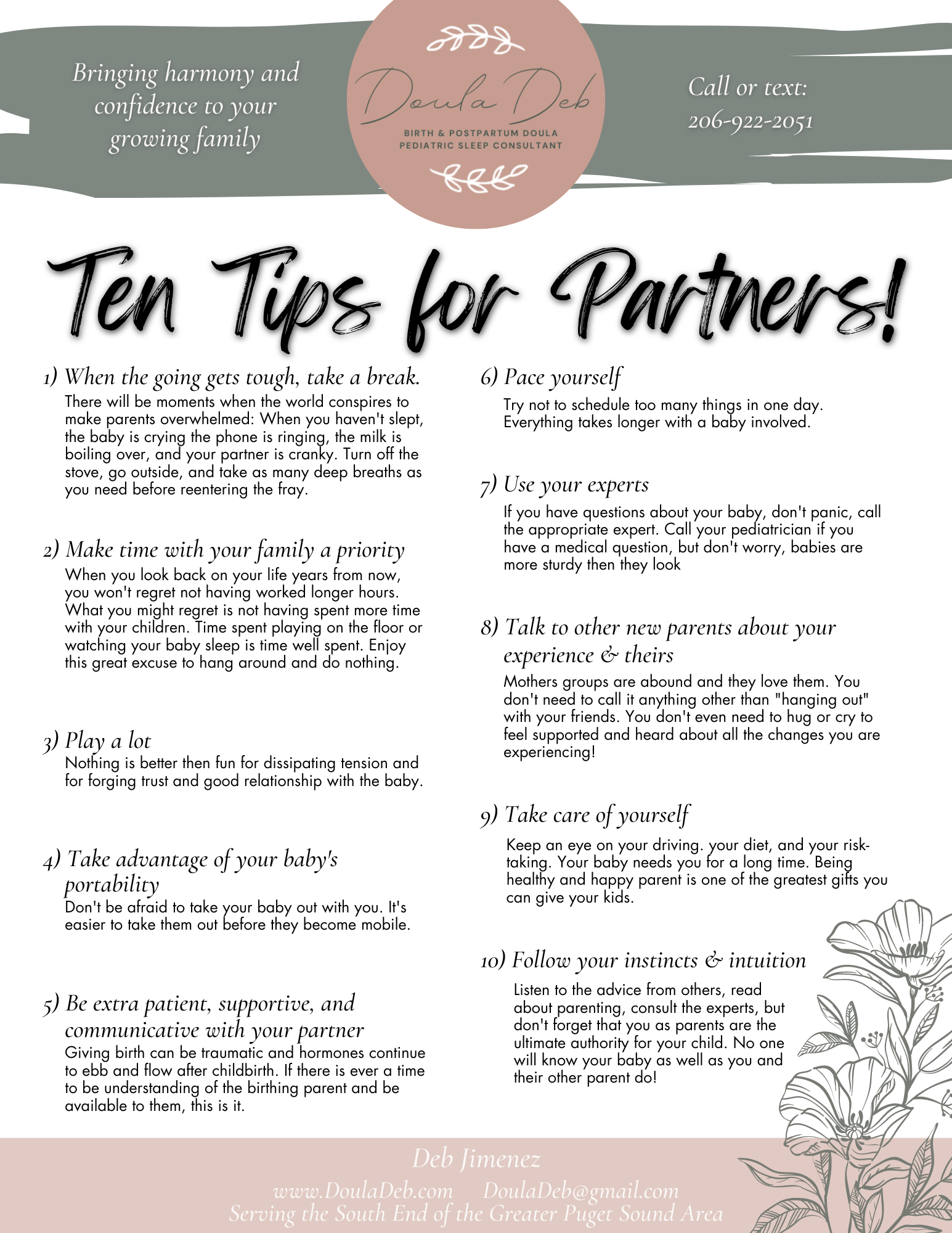
Get access to this download and more here!
Final Thoughts
The first year of parenting can feel intense because it is intense.
You are learning how to care for a baby while simultaneously trying to care for yourselves, your relationship, your finances, your jobs, and your mental health.
That is a tremendous amount for any family to carry.
So if things feel hard right now, that does not mean you are failing.
Slow down where you can.
Support each other where you can.
Laugh when possible.
Apologize when needed.
And remember that you are on the same team.
Even when everyone is tired.
If you’d like more support during the newborn or first-year stage, you can learn more about my postpartum, sleep, and First Year Support services through Doula Deb. I specialize in practical, gentle support that helps families feel more steady, connected, and rested during the transition into parenthood.
Until next time, remember, we’re all figuring this out one baby step at a time. Keep breathing, keep smiling, and know that you’ve got this.
Warmly,
Doula Deb
Resources here:
Offers:
First Year Support Program – for sleep, sanity, and support through every stage